Table of Contents (19 sections)
How to Find Winning Products for Dropshipping Using AI
Most dropshippers have already tried asking an AI chatbot to "find me a winning product" and gotten back a list of generic suggestions that could have come from any month, any niche, and any seller who typed the same lazy question. The result feels like research, but it isn't. An AI assistant is only as useful as the data it can actually see and the instructions you give it, and neither of those improves just because the word "AI" is now part of your workflow.
The method that actually works combines two things: a live source of real product and advertising activity, and a genuinely specific, criteria-based research brief that tells the AI what a good candidate looks like before it starts searching, not after. Get those two pieces right and an AI assistant can do in minutes what used to take hours of manually scrolling ad libraries and spy tools, then hand you a shortlist you still have to validate yourself rather than launch on faith.
Disclosure: Some links in this article are affiliate links. We may earn a commission if you sign up or purchase through them, at no additional cost to you. This never changes which platforms or tools we cover or how we describe them.
Why the usual shortcuts keep surfacing the same products
Three habits explain most of the "everyone is selling the same thing" complaints in dropshipping communities, and none of them are really about AI.
The first is relying on one of the large, generic product-research databases that thousands of other sellers already use. When a tool is popular enough, its top-sorted results stop being an edge and start being a starting line everyone crosses at the same time.
The second is scrolling social platforms hoping to spot the next viral product. A video with heavy engagement is a real signal of attention, but attention is not proof of sales. Millions of views tell you nothing about whether the advertiser is actually profitable, who else is running the same product, or how long the trend has left.
The third is typing a vague request into an AI chatbot and treating whatever comes back as research. Without a connected, current data source, a general-purpose AI model is drawing on training data that may already be months or years old. It can describe what a good product generally looks like, but it cannot tell you what is actually selling this week unless something feeds it that information directly.
The two ingredients AI-assisted product research actually needs
Skipping either of the following two pieces is why most "I used AI to find a product" attempts produce the same generic output as a plain chatbot conversation.
A live product and advertising data source
An AI assistant needs something to query beyond its own training data: a continuously updated feed of active stores, running advertisements, ad age, and momentum. Several dropshipping-focused research platforms track this kind of data, and the specific one you use matters less than whether you actually connect it to your AI workflow instead of scrolling it manually.
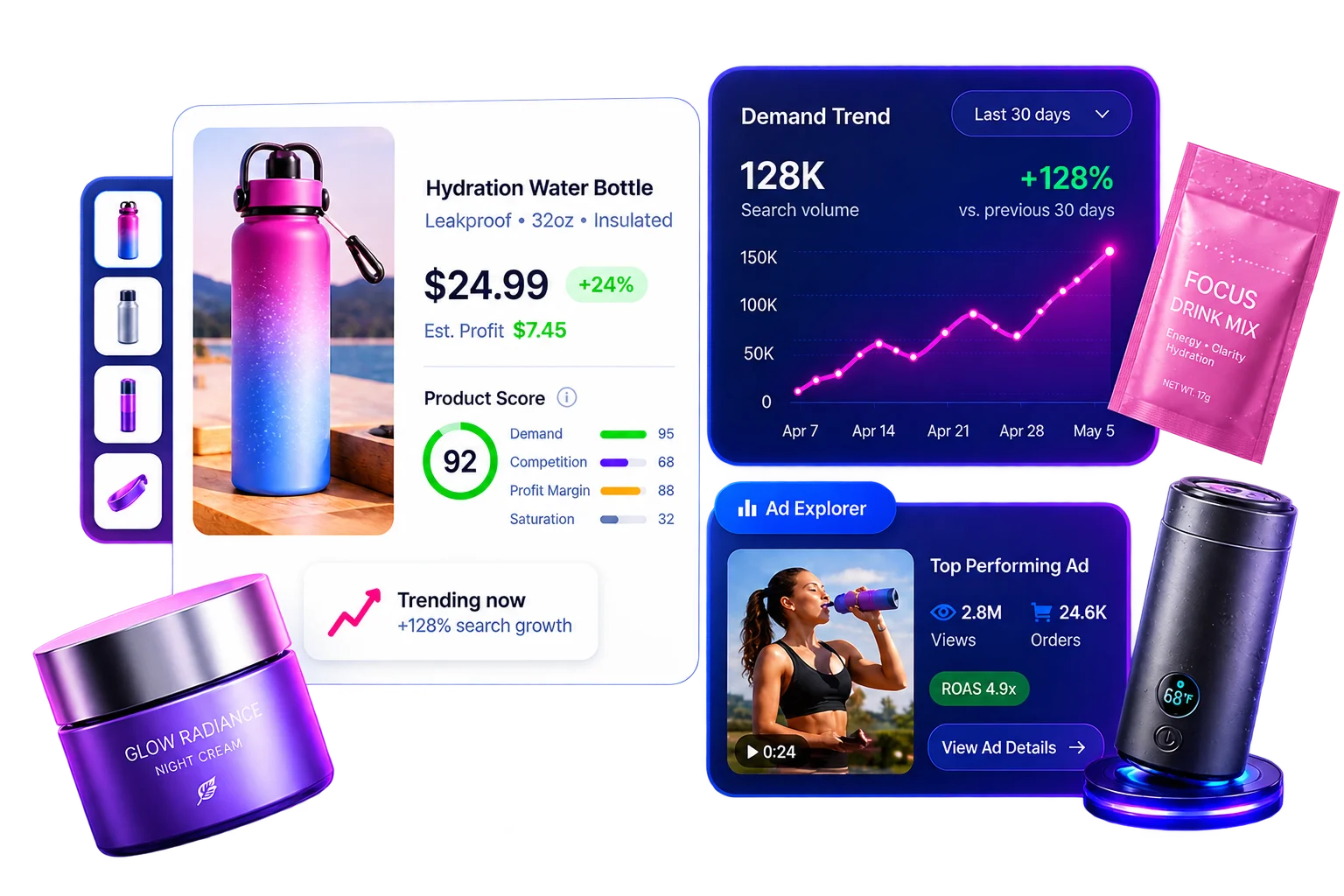
This is the same idea behind Dropmind's Winning Products and Ads Explorer: pairing a continuously updated product and advertising database with AI-assisted interpretation, so you are prioritizing a shortlist instead of manually sorting a firehose of listings and ad accounts yourself.
A criteria-based research brief, not a one-line request
An AI assistant given "find me winning products" has to guess what you mean by winning. Given a real brief with explicit screening criteria, it has something concrete to filter against. Useful criteria for a dropshipping-style product commonly include:
- Understandable fast. Could a stranger grasp what the product does within about three to five seconds of seeing it?
- Impulse-buy price range. Priced low enough, or positioned strongly enough, that a first-time visitor can decide quickly without a long consideration cycle.
- Room for a real margin. Enough gap between landed cost and a defensible selling price to fund testing, not just a thin markup.
- Broad enough audience. A problem shared by a large enough group of people that the product can scale past a handful of early buyers.
- Works as short-form video. Demonstrable in a few seconds of footage, since most cold traffic today arrives through short-form content.
- Positive momentum. Advertising activity that is holding steady or growing, not a product whose ads have been quietly declining for weeks.
Put those together into a written brief instead of a one-line request, and you give the AI something a real researcher would actually use. A simple version looks like this:

Scope: a specific niche, or "the strongest opportunities across every niche."
Timing: the current month, so seasonal categories are weighted correctly.
Screening criteria: your specific list, such as the six above.
Momentum requirement: advertising activity that is scaling or stable, not declining.
Requested output: price, competitor site, ad count and momentum, an estimate of reach, and a plain verdict.
Two questions to answer before you run the search
Two inputs change the results more than anything else in the brief: which niche, and which month.
Choosing a niche narrows the search to a category you already understand or want to build a store around. Choosing "the best opportunities across every niche" instead is a reasonable option if you are still deciding what to sell, though the results will need more filtering before any single one looks obviously right.
Specifying the current month matters because product demand is seasonal in ways that are easy to overlook. A search run in August should already account for kitchen and gift-adjacent categories heading into their strongest window as fall cooking and Q4 gifting approach, while a search run in January would weight differently. An AI assistant with no timing instruction defaults to whatever its training data happens to emphasize, which is not the same as what is actually in season right now.
What a useful shortlist should actually tell you
A well-built research brief should return more than a bare list of product names. For each candidate, look for:
- Price. What it is currently being sold for.
- Traffic direction. Whether the leading competitor's store traffic looks like it is climbing or fading.
- Ad count and momentum. How many creatives are currently active, and whether that number has been growing or shrinking recently.
- Estimated reach. A directional sense of scale, not an exact revenue figure.
- A plain verdict. Something closer to "worth testing now," "worth watching," or "already declining" than a bare score.
Treat every field on that list as a signal, not proof. A rising ad count usually means an advertiser sees enough value to keep spending, and that is a genuinely useful thing to know. It still does not tell you the advertiser's actual margin, return rate, or whether the same product would work with your own creative and offer. For a broader framework covering demand, competition, margin, and data confidence together, see Dropmind's guide to building a repeatable winning-product research framework.
Validate before anything goes on your test list
An AI-generated shortlist is a starting point, not a decision. Before adding a candidate to your test list, work through the same checks a careful researcher would run by hand.

Read the actual value proposition. Open the leading competitor's product page and see how the product is actually being positioned. A product that looked interesting as a thumbnail can turn out to be a plain commodity item once you read the real page, or it can turn out to be genuinely differentiated in a way the shortlist alone did not capture.
Check the ad library, not just the ad count. Search the product in the relevant platform's public ad library and look at the actual creative angles being used. Also check whether the seller is running ads under more than one page or account. A brand advertising the same product under multiple identities is usually a sign of a more serious, longer-running test than a single page with a handful of creatives.
Check whether traffic is rising or falling. A store-traffic checking tool or browser extension can show whether a competitor's monthly visits have been climbing or sliding. A product that is scaling looks very different from one riding out the tail end of its momentum, even if both currently show similar ad counts.
Add it to cart to see the upsell structure. Bundles, accessory attachments, and multi-unit discounts at checkout tell you two things at once: whether the seller has found real ways to raise average order value, and what your own offer might need to include to compete.
Log every candidate in a research tracker
Without a place to record what you find, you end up re-researching the same handful of products every few weeks. A simple tracker with one row per candidate keeps your research cumulative instead of disposable.
| Field | What to record |
|---|---|
| Product name | Working name for the candidate |
| Niche | Category or audience it fits |
| Competitor reference | URL of the leading example you found |
| Supplier cost | What you can actually source it for |
| Selling price | What the competitor is charging |
| Margin | Selling price minus supplier cost and estimated fees |
| Problem solved | The specific need it addresses |
| Target customer | Who the competitor's ads and page speak to |
| Upsell ideas | What you saw at checkout, or your own bundle idea |
For the supplier-cost row, check pricing against your existing sourcing setup rather than assuming the number on a competitor's page reflects real landed cost. If you are still comparing sourcing options, a supplier platform such as CJdropshipping can show current per-unit pricing and shipping times for a similar item, and Dropmind's guide to vetting dropshipping suppliers covers more of these options if you want a fuller comparison.
The kind of products this process tends to surface
The value of a criteria-based, data-connected search is that it tends to surface specific, non-obvious products rather than the same handful everyone already recognizes. In practice, that has meant categories such as: a gentle wearable device positioned around helping someone wake up on time without a jarring alarm, marketed partly to parents of children who struggle with mornings; a screen-free toy pitched around building a child's independent play instead of another few minutes of tablet time; a manual gift-style kitchen tool, like a hand-operated knife sharpener sold as a thoughtful present rather than a bare utility item; and premium cooking accessories timed to the run-up to fall cooking and holiday gifting. These are illustrative categories, not verified results, and none of them are a reason to skip your own validation steps above.
Remember: finding the product is only step one
A validated candidate is a starting point, not a finished business. You still need to source the product, build a store and an offer around it, produce creative, launch ads on at least one platform, and get through the early, uneven stretch before you know whether it actually converts for you. If you have not sourced and negotiated with a supplier before, Dropmind's beginner supplier-sourcing blueprint covers that next step in more detail, and the step-by-step guide to launching a Shopify store covers what comes after that.
Common mistakes to avoid
- Treating the shortlist as a final answer. An AI-generated list is a set of candidates worth checking, not a set of products worth launching untested.
- Using a vague, one-line prompt. "Find me a winning product" produces generic output regardless of which AI model you use.
- Ignoring momentum direction. A product with a high ad count but declining activity is a different opportunity than one that is actively scaling.
- Skipping the ad-library check. A product that looked unique on the shortlist can turn out to already have several established competitors once you actually search for it.
- Forgetting to specify the month. A result generated without a timing instruction can weight the wrong season entirely.
- Not logging candidates. Without a tracker, you end up re-researching the same products every few weeks instead of building on what you already found.
Frequently asked questions
Do I need a paid research tool to do this?
No. The underlying method, criteria-based brief plus a live data source plus manual validation, works whether the data comes from a paid platform or from research you compile yourself. A connected data source mainly buys speed and consistency, not something manual research makes impossible.
Can I just ask a general AI chatbot to find me a winning product?
You can ask, but without a connected, current data source the model is drawing on training data that is not up to date on what is actually selling right now. It can help you think through criteria and structure a brief. It cannot substitute for a real, current data feed.
How specific does my prompt actually need to be?
Specific enough that a human researcher could follow it. If your brief only says "find good products," you have not given the AI anything to filter against. A brief with explicit criteria, timing, and a requested output format gives it something concrete to work from.
How do I know if a product's ad momentum is real?
Check the ad count over time rather than a single snapshot, and confirm activity in the platform's own ad library rather than relying on a research tool's summary alone. Multiple active creatives and more than one advertiser page running the same product are both stronger signals than a single ad that happens to still be live.
Does appearing on a shortlist mean a product will sell?
No. A shortlist, including Dropmind's own Winning Products, is a research starting point built from available signals, not a guarantee. Product performance still depends on your offer, creative, pricing, and execution.
How often should I rerun this search?
Rerunning it every few weeks, or whenever you specify a new month in the brief, keeps results aligned with the current season instead of stale ones generated months earlier.
The bottom line
AI does not replace product research. It replaces the slowest, most repetitive parts of it, scrolling ad libraries by hand and cross-referencing store traffic one tab at a time, once it has a live data source to query and a specific brief telling it what to look for. Build the criteria once, reuse the brief every time you search, and treat every result as a candidate to validate rather than a product to launch. Dropmind's Winning Products and Ads Explorer are built around that same combination, a continuously updated product and advertising database paired with AI-assisted scoring and the reasoning behind it, so you can run this process without setting up your own data connection first.